Oh dear, week 3 and already deviating from the schedule that I set myself and no one will hold me to if I decide to do something different…
Yes, yes, indeed, because schedules are more like guidelines anyway. But really it’s because, even though this blog will eventually be full of my scattered witchy wanderings, I would like to have a bit of a thread to follow every now and then. September has crept up on us and one of the many things I want to explore is The Wheel of the Year and all it entails.
The next one up is Mabon (or one of the many other names which we will get into this Friday [20/09] ) which is closer than you might think and if I stick to my self-made schedule, my post about Mabon would be a week late.
So here we are, a little in betweener, a little taster, a little introduction into The Wheel of the Year before we head straight into the actual spokes of it. Let’s go.
Almost every single source I’ve found describes The Wheel slightly different. The Wheel of the Year is both old and new, both modern and ancient, both set and slightly flexible. It seems deeply rooted in our history and humanity to celebrate specific times on our mother Earth. It’s something found in many cultures around the world and it seems to at least agree on one thing: that mother Earth is a glorious entity which we must honour and celebrate.
As Temperance Alden puts it in her book ‘Year of the Witch’: “No one specific culture can lay true claim to celebrating things such as the moon, sun, season, harvest, solstice, equinox, storm, or really any other facet of nature. It is in our very souls to celebrate, acknowledge and give praise to the things that make us feel alive.” (p.92)
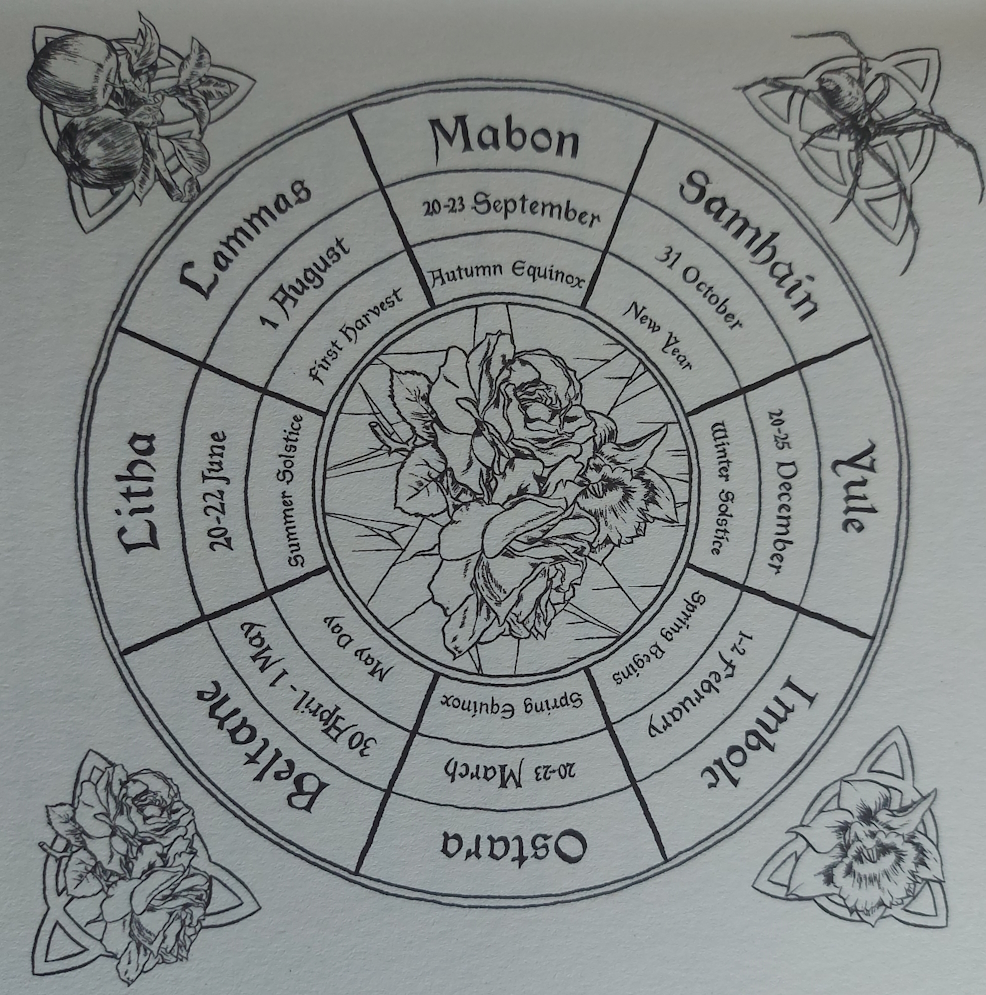
The Wheel of the Year as it is popularized now, an eight spoke circle of seasonal festivals, came to be in the mid-20th century through Wiccan and Neo-pagan movements. But it was inspired by a mix of ancient festivals and solar events, marking beginnings, peaks, and endings of the seasons. On the wheel, there are eight spokes, representing Greater and Lesser Sabbaths.
The four main festivals, Greater Sabbaths: Samhain, Imbolc, Beltane, and Lughnasadh, based on Celtic fire festivals. In between these festivals are the solar festivals, Lesser Sabbaths: Yule (Winter Solstice), Ostara (Spring Equinox), Litha (Summer Solstice), and Mabon (Autumn Equinox).
I can’t fact check this next bit specifically because this is purely my feelings and opinions, but this is my two cents on The Wheel. I feel like we lost so much to history, whichever major event you might want to blame, war, witch hunts, monotheism, or simply time passing without humans having a bulletproof way to conserve information. So much was lost, and with the few ideas we have left, we can honour our ancestors and the way they used to live alongside mother Earth and nature. For that reason, I’m happy we have something like The Wheel of the Year, not every Sabbath might make sense now, not every festival might resonate. But I’m excited to learn and find out more about the history even if it might just all be about farming and food.
The first one up is the Autumn Equinox, or Mabon, 20th to the 23rd of September. Why is it called Mabon, what does the Autumn Equinox mean? Well, guess we’ll find out Friday.
Picture credit: this illustration is used in the book ‘The Wheel’ – Jennifer Lane, which I took a picture of to serve as an illustration with this blogpost.


